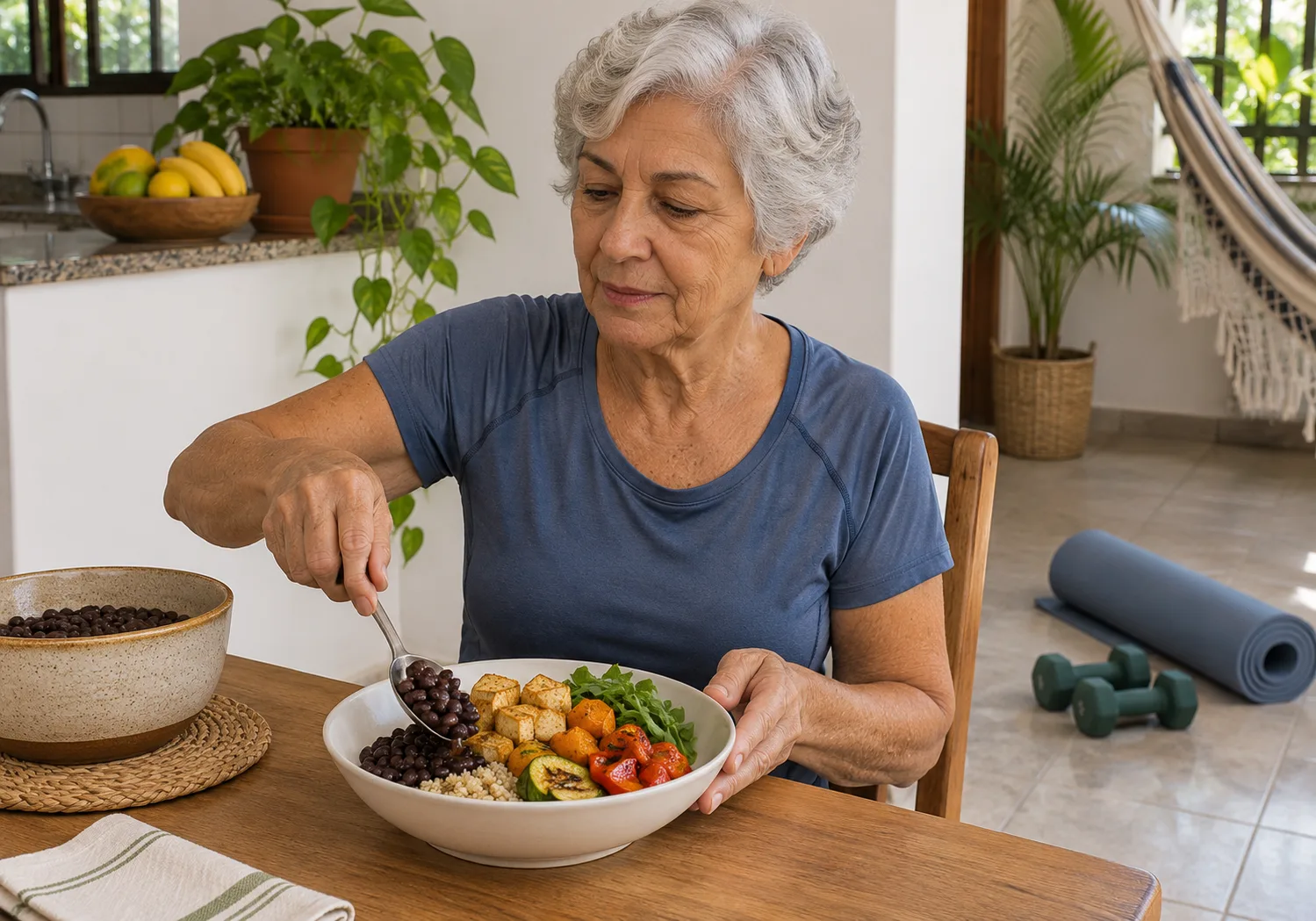
Healthy older adults who adopted a vegan diet lost thigh muscle volume over 12 weeks in a trial conducted in the Netherlands. The loss was smaller among participants who also did supervised strength training. The dietary change was accompanied by a drop in protein intake, even with nutritional guidance.
Published in The American Journal of Clinical Nutrition, the study followed 72 adults aged 65 or older. Participants chose their own foods, and the diets were not adjusted to provide the same amount of protein or energy across the different groups. For this reason, the findings do not allow the muscle loss to be attributed to the plant origin of the protein, nor do they support the conclusion that every vegan diet produces the same effect.
How the study was done
Participants were randomly assigned to three groups: a vegan diet, their usual omnivorous diet, and a vegan diet combined with strength exercises twice a week. The average age was 72. The sample included healthy, physically active people who did not follow a vegetarian or vegan diet before the study. Of the 72 participants, 70 completed the intervention.
All groups received nutrition information at monthly meetings. In the vegan groups, support included food substitutions, recipes and guidance materials. Protein and other nutrients relevant to older adults were discussed. Protein intake dropped even with this general support.
Training attenuated the loss
The primary outcome was the change in thigh muscle volume, measured by MRI. Adjusted estimates indicated a reduction of 0.61 liter in the vegan group, with a 95% confidence interval of 0.50 to 0.72 liter of loss. In the vegan group with training, the reduction was 0.35 liter, with a 95% confidence interval of 0.24 to 0.47 liter. In the omnivorous group, the change was close to zero. Exercise attenuated the loss without preventing it entirely.
Lean mass in the arms and legs also declined more in the vegan group without training. This measure was obtained by DXA, a scan that assesses lean tissue, a category that does not correspond exclusively to muscle. The result complements the MRI findings but does not represent whole-body muscle loss.
The role of protein and weight
In the vegan group, protein intake fell from approximately 1.0 to 0.7 gram per kilogram of body weight per day, as described by the authors in the discussion. Muscle protein synthesis, the process by which new proteins are produced in muscle, was also lower in this group. This measure was assessed only during the first ten days and does not cover the full 12 weeks of the trial.
According to Hamilton Roschel, a researcher at the Universidade de São Paulo who was not an author of the trial, the design does not allow the effect of the protein's plant origin to be isolated. He highlights the reduction in protein intake and the weight loss when interpreting the results. The study, however, did not show how much each factor contributed to the change in muscle.
Both vegan groups lost weight: about 2.9 kilograms without training and 2.7 kilograms with training. This does not prove that they consumed fewer calories. Food records showed no statistically significant difference between groups in the change in energy intake. The authors discuss a possible negative energy balance, inferred from the weight loss, and the possibility of less efficient absorption of energy from food.
The reduction in protein intake may have contributed to the muscle loss. The trial does not allow the separate roles of protein quantity, protein quality and other dietary changes to be quantified. Nor did it evaluate a vegan diet adjusted to keep protein intake at the same level as the omnivorous diet.
Muscle mass is not the same as function
Differences in strength measures did not remain statistically significant after correction for multiple comparisons. The reduction in muscle volume, therefore, does not by itself demonstrate a loss of strength or independence. Nor does the trial support the conclusion that the diet increased falls or caused sarcopenia.
“Muscle mass is an important indicator, but it is not the same as function,” says Roschel. This distinction limits what can be concluded about the effects of the dietary change on everyday activities.
Meal planning in Brazil
Regarding application in Brazil, Roschel stresses the importance of individual planning and cites rice and beans, soy, textured soy protein and other legumes among the available options. He recommends paying attention to protein and energy intake, vitamin B12 supplementation and the adaptations needed for conditions such as kidney disease or frailty.
These recommendations reflect Roschel's clinical assessment. The trial did not compare vitamin B12 supplementation strategies or specific interventions for kidney disease or frailty. Dietary needs and exercise programs must take each person's health context into account.
Body fat and the trial's limitations
The vegan groups also showed reductions in visceral fat and liver fat. These results should be considered alongside the changes in weight and muscle. Roschel notes that the effects occurred over a short period and that it is unknown whether they will be sustained.
The study lasted 12 weeks and included healthy, very active older adults. There was no omnivorous group with strength training. Its results cannot be automatically extended to frail older adults, younger people, long-term vegans or diets planned differently. Nor do they establish universal equivalence between protein sources.
The study was funded by Regio Deal Foodvalley. Authors disclosed research ties or compensation related to the food industry, including animal- and plant-protein companies. According to the article, the funders played no role in the design, data collection and analysis, the decision to publish or the preparation of the manuscript.
The results draw attention to planning the dietary transition after age 65, with monitoring of protein intake, weight and body composition. Strength and functional capacity require their own assessment. The trial does not establish a universal dietary prescription.
References actually consulted
Domić J, Grootswagers P, Pinckaers PJM, Melchers M, van Loon LJC, de Groot LCPGM. A self-selected vegan diet reduces skeletal muscle mass in healthy older adults: a randomized controlled trial. The American Journal of Clinical Nutrition. 2026;124:101416. DOI: 10.1016/j.ajcnut.2026.101416. Full article, 15 pages.
Appendix A of the same article, with six tables and four figures, including the CONSORT flow diagram. Full reading and inspection of the figures