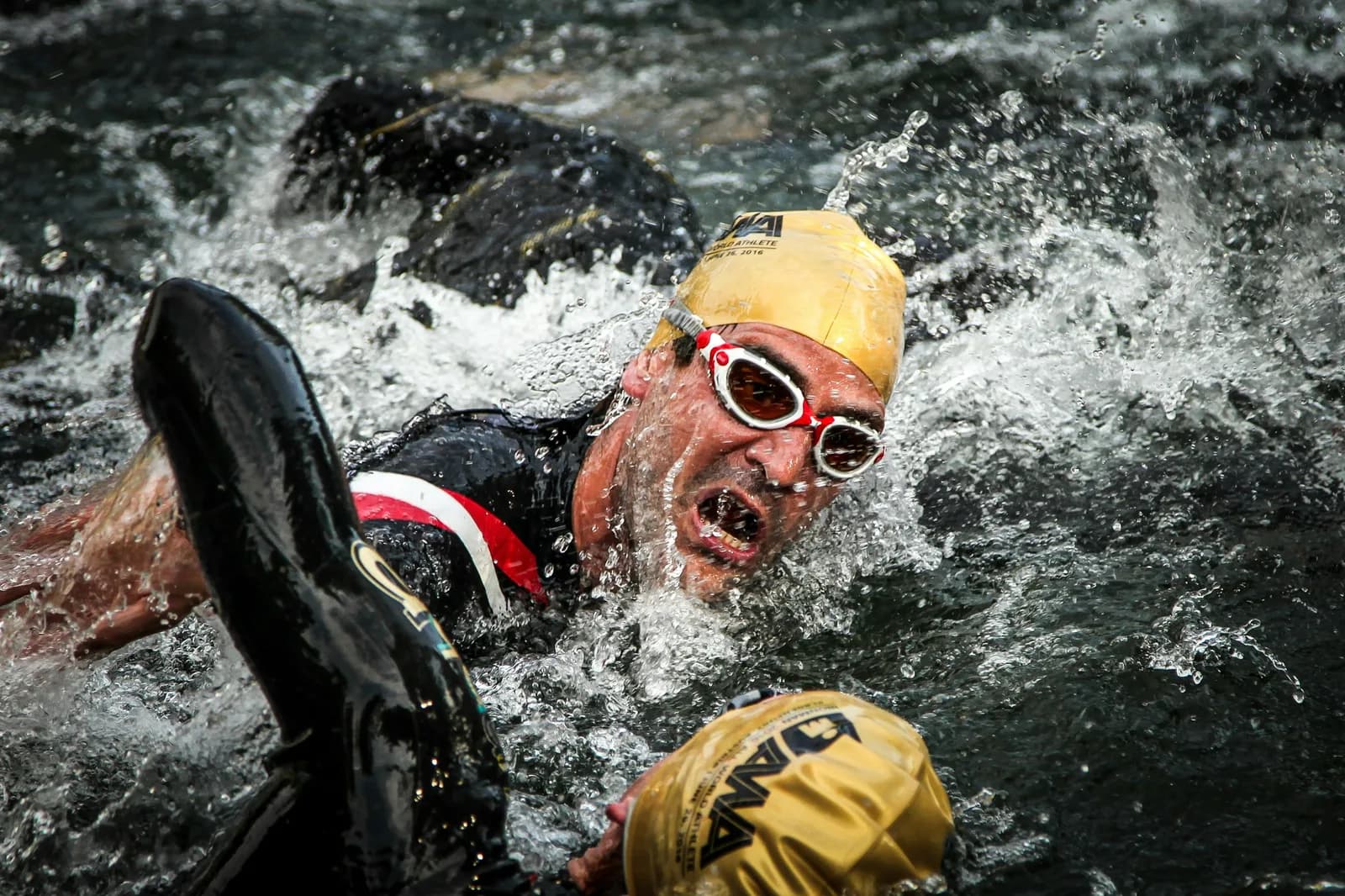
For anyone taking on a long-distance race, a cramp can mean much more than a few minutes of pain. The Ironman consists of a 3.8-kilometer swim, 180 kilometers of cycling and, finally, a marathon. After hours of effort, an involuntary muscle contraction can throw off the pace, undermine the race strategy and turn the remaining kilometers into an even bigger challenge.
The problem is well known among athletes, but important questions remain. Why do some people seem to suffer from cramps again and again, while others go through similar situations without any trouble?
For a long time, one of the most widespread explanations was a lack of water and the loss of minerals. Science, however, paints a less simple picture.
A Brazilian study conducted during Ironman Brasil found an important clue in the athlete's own history.
Published in the German Journal of Exercise and Sport Research, the study examined personal characteristics, training, previous cramping episodes and strategies planned for the race. Participants who already reported the problem — especially those who considered their episodes frequent — had higher odds of new cramps during or immediately after the race.
The researchers stress that the analysis is exploratory and that the results should be interpreted with caution.
For Fabio Sprada, a coauthor of the paper and head physical therapist for the Ironman Triathlon in Brazil, the finding raises a possibility:
“There does seem to be an individual predisposition.”
But finding that some people seem more prone to cramps is different from finding out why.
Sprada considers it possible that neurophysiological components are involved in this recurrence. The study, however, did not directly investigate those mechanisms. The hypothesis helps frame new questions, but it is not a demonstrated cause.
Athletes who have had cramps before deserve closer attention
The final analysis included 136 triathletes who completed the Ironman. Before the race, they answered questions about age, sex, height, body mass, training, cramping history and the perceived frequency of their cramps. They also reported their hydration and nutrition plans.
After the race, the researchers checked who had experienced cramps during or immediately after the competition and whether participants had followed the strategies they had set in advance.
Of the 136 athletes analyzed, 33 reported cramps. Among them, 73% had a previous history of the problem. In the group that did not have cramps during the race, the figure was 43%.
When the researchers looked at how often previous episodes had occurred, a gradient emerged.
Compared with participants with no history, those who considered their previous cramps infrequent had 3.2 times higher odds of new episodes. Among those who reported frequent cramps, the odds ratio reached 19.7.
The number is striking, but it should not be read as “20 times the risk.”
The confidence interval for this estimate was very wide — from 3.2 to 122.7 — and there were few participants in the group reporting frequent cramps. In addition, “frequent” and “infrequent” were classifications made by the athletes themselves, with no number of episodes defined in advance by the researchers.
In practice, the result does not make it possible to predict on an individual basis who will cramp in their next race. It points to something simpler and more relevant: an athlete's history may offer a clue about the chance of new episodes.
Cramping history had already appeared in previous research as a factor associated with new episodes. For physical therapist Guilherme Nunes, the study's author, who holds a PhD in physical therapy from UFSCar, one of the new study's contributions is looking not only at whether an athlete has had cramps before, but also at how often they perceive them happening.
“The present study shows that not only the history, but also the perceived frequency with which these cramps occur is important,” says Nunes.
The results therefore suggest that this perceived frequency may add information beyond history alone. The finding, however, needs to be confirmed in larger studies before it can be used to estimate an individual's likelihood of new episodes.
Are cramps a sign of dehydration?
This is where the study touches on one of the best-known beliefs in sports.
Nearly all participants had a hydration plan for the race. Among those who had cramps, ten said they had not followed the plan. Among those who did not have cramps, 16 said the same.
In the statistical model, not following the plan was associated with roughly three times higher odds of cramping.
It would be tempting to turn this result into a simple explanation: those who didn't hydrate properly had more cramps.
But that is not what the study measured.
“We didn't measure how much water the athletes drank. We only checked adherence to the hydration plan,” explains Sprada.
The difference is crucial.
An athlete could have abandoned the plan by drinking less than intended, but could also have drunk more. The study did not quantify fluid intake well enough to determine each participant's hydration status.
For that reason, it is not possible to conclude that dehydration caused the episodes observed.
Nunes believes the result reinforces the importance of an individualized hydration strategy and of sticking to it during the race. But this finding must be understood within the limits of what was actually measured: adherence to the plan, not the amount of water consumed or physiological hydration status.
It would also be wrong to flip the result and claim that following the plan cuts the chance of cramping threefold. The researchers found an association; they did not carry out an intervention to test whether a given behavior prevented the problem.
Which came first?
There is another question the data cannot fully answer.
Cramping history and race plans were recorded before the Ironman. The occurrence of episodes and whether athletes had followed their hydration plan were checked afterward.
That leaves an open question: did the athlete change strategy and then cramp, or did some problem during the race cause them to abandon what they had planned?
The study did not record this sequence for each individual.
So the relationship between hydration planning and cramps is relevant, but it does not establish a chain of cause and effect.
Why do some people seem more prone to cramps?
This may be the most intriguing question the study leaves behind.
If previous history keeps showing up as associated with new episodes, what sets these athletes apart?
Among the possibilities discussed in the paper itself are fatigue-related changes in neuromuscular control and individual differences in predisposition to cramps. The Brazilian study, however, did not directly measure these mechanisms.
For that reason, these explanations remain hypotheses, not causes demonstrated by the study.
Likewise, the results do not allow hydration and electrolytes to be folded into a single explanation. The research did not directly measure dehydration, electrolyte concentrations or the volume of fluids consumed.
The conclusion, then, is not that water and minerals are irrelevant. It is that the phenomenon cannot be explained by them alone based on the data from this study.
Not everything investigated turned out to be associated
The researchers assessed a range of other participant characteristics, including age, sex, height, body mass, training, flexibility and aspects related to race performance.
These variables were not among the main factors associated with cramps in the final model.
That does not mean they are irrelevant for every athlete or sport. It means that, in this population and in this analysis, they did not show the same association observed with previous cramp frequency and adherence to the hydration plan.
What the study still can't answer
The results need to be viewed within the study's limitations.
The study started with 298 participants, but 136 made it to the final analysis. Of these, 33 had cramps. The researchers compared the characteristics of those who did and did not respond to follow-up, but participant loss remains a limitation.
There is also the statistical issue. The paper itself classifies the multivariable analysis as exploratory, given the number of participants, cases and potential factors initially investigated.
That does not make the results irrelevant. It means they need to be confirmed in new studies before they can support broader conclusions.
The most solid finding remains this: among the triathletes studied, previous cramp frequency and adherence to the hydration plan were the variables that remained associated with episodes in the final model.
Can cramps be prevented?
For anyone who has had to slow down or stop in the middle of a race because of a cramp, this is probably the question that matters most.
The scientific answer still doesn't fit into a single recipe.
Various preventive strategies are being investigated, but the current study did not test an intervention designed to prevent cramps. Its results therefore do not support the conclusion that any particular strategy prevents new episodes.
And this is exactly where Nunes draws an important distinction between identifying associated factors and knowing how to prevent the problem:
“It's important to emphasize that none of this information speaks to effective management in preventing cramps.”
According to the researcher, the findings can provide relevant information for planning preparation and performance during an Ironman race, especially when the athlete already has a recurring history.
Sprada also considers it important to stick to an individualized hydration strategy established during training.
These are the researchers' interpretations and recommendations. The study did not show that following a hydration plan prevents cramps.
Perhaps the most immediate application of the results lies one step before prevention: recognizing that athletes with recurring episodes deserve individualized attention during their preparation.
Rather than looking for a single explanation or a quick fix, history can serve as a signal to observe the circumstances in which cramps occur and which factors keep repeating across training and competition.
The new study adds one piece of information to this assessment: beyond knowing whether an athlete has had cramps, looking at how often they report these episodes may help identify who deserves closer attention.
It remains to be discovered which mechanisms explain this greater propensity and, above all, which interventions can actually change it.
_______________
References
Haupenthal A, Piussi JB, Oliveira VF, et al. Risk factors for the occurrence of cramps during the Ironman Triathlon: a longitudinal study. German Journal of Exercise and Sport Research. 2026. doi: 10.1007/s12662-026-01148-y. Springer
Schwellnus MP, Drew N, Collins M. Increased running speed and previous cramps rather than dehydration or serum sodium changes predict exercise-associated muscle cramping: a prospective cohort study in 210 Ironman triathletes. British Journal of Sports Medicine. 2011;45(8):650–656. doi: 10.1136/bjsm.2010.078535. Springer
Miller KC, McDermott BP, Yeargin SW, Fiol A, Schwellnus MP. An evidence-based review of the pathophysiology, treatment, and prevention of exercise-associated muscle cramps. Journal of Athletic Training. 2022;57(1):5–15. doi: 10.4085/1062-6050-0696.20. PubMed
Nilssen PK, Johnson KB, Hiller WDB, Miller TK, Connolly CP. Exercise-associated muscle cramps in Ironman-distance triathletes over 3 decades. Clinical Journal of Sport Medicine. doi: 10.1097/JSM.0000000000001276. PubMed
Garrison SR, Korownyk CS, Kolber MR, et al. Magnesium for skeletal muscle cramps. Cochrane Database of Systematic Reviews. 2020;(9):CD009402. doi: 10.1002/14651858.CD009402.pub3. Cochrane
Hawke F, Sadler SG, Katzberg HD, Pourkazemi F, Chuter V, Burns J. Non-drug therapies for the secondary prevention of lower limb muscle cramps. Cochrane Database of Systematic Reviews. 2021;(5):CD008496. doi: 10.1002/14651858.CD008496.pub3.